Frequently asked questions
Honest answers about our plant fiber technology and what to expect when you switch to ENAMÜR.
- Clinically proven
- Low abrasion
- Made in the USA
- Ships from the USA
The technology
What's in the tube, and why.
What is ENAMÜR?
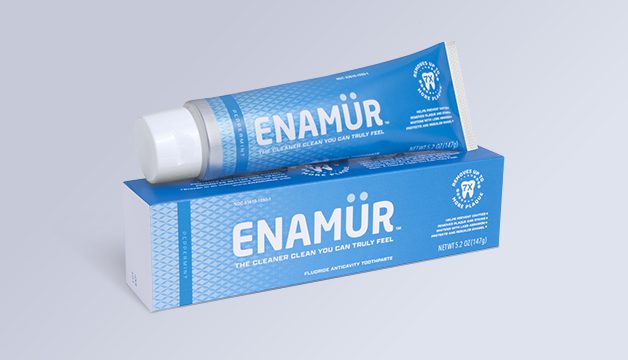
ENAMÜR is a fluoride anti-cavity toothpaste made in the USA. Instead of the synthetic polymers in conventional toothpaste, it uses a patented, all-natural plant fiber network (microfibrillated cellulose) that grips and lifts plaque so normal brushing removes up to 7X more — with low-abrasion whitening and no peroxide, SLS or parabens. Its results are published in two peer-reviewed journals.
Source:The Science — ENAMÜR studies
What makes ENAMÜR different?
ENAMÜR replaces the synthetic polymers found in conventional toothpaste with an all-natural plant fiber network. This novel approach boosts the efficacy of your toothbrush and mechanically removes up to 7X more plaque and biofilm with normal brushing.
What is the plant fiber technology in ENAMÜR?
ENAMÜR is made with soft, all-natural, microfibrillated cellulose fibers from trees sourced from sustainably managed forests. Our patented technology creates an elastic 3-dimensional network of these tiny microfibrillated cellulose fibers. The microfibrillated cellulose is what makes the difference.
Source:Journal of Dentistry · Jul 2024 (abrasion, stain & fluoride study)
Is the microfibrillated cellulose chemically processed?
No, not at all. Microfibrillated cellulose (MFC) is an all-natural renewable material. Cellulose is the main component of plant cell walls, and MFC is created by mechanically shearing structural cellulose fibers.
Is the cellulose safe to use?
Absolutely. Microfibrillated cellulose has been extensively studied and used in food products. While you should never swallow toothpaste, microfibrillated cellulose is commonly used in food products as a stabilizer and thickener.
Will I be able to feel, taste or see the cellulose fibers?
No, not at all. Microfibrillated cellulose is undetectable to human senses.
Using ENAMÜR
Brushing, foam, and what the first week feels like.
What should I expect from brushing with ENAMÜR?
ENAMÜR stands up on your brush — it's a little sturdier than most toothpastes and won't sink into the bristles. The peppermint flavor is freshening, but not too strong. There will purposely be less foam at the beginning of the brushing cycle and more at the end of your brushing cycle (assuming at least a 2-minute brush), because ENAMÜR doesn't immediately break down into a saliva slurry. After you brush, spit and rinse, expect the cleaner clean you can truly feel — smooth teeth, closer to a professional cleaning. When you brush right before bed, you may notice your teeth feel cleaner than usual when you wake up.
Why did you design ENAMÜR to foam less?
Many toothpastes use industrial surfactants such as Sodium Lauryl Sulfate (SLS) to foam quickly, forming a slippery saliva slurry that can actually inhibit your toothbrush's ability to remove plaque and stains. ENAMÜR uses Cocamidopropyl Betaine, a coconut oil-derived foaming agent — ENAMÜR doesn't break down with normal brushing speeds and won't immediately turn into a slurry, create a foamy mess, or negatively impact your brushing routine.
Source:Journal of Dentistry · Jul 2024 (abrasion, stain & fluoride study)
Does it matter if I use a manual or mechanical toothbrush?
No. The clinical study demonstrating up to 7X more plaque removal was conducted with a manual toothbrush, but mechanical brushes work well too. We recommend using a generous bead of ENAMÜR covering the head of the brush. Some mechanical brushes have very small heads — apply as much as possible, then apply again after the second beep or the half-way point of the electric brushing cycle.
How much should I use?
Cover the brush head with a generous bead — the fibers are activated by the motion of your toothbrush and contact with your teeth and gumline, so make sure to use enough ENAMÜR to reach everywhere you brush. On small mechanical brush heads, re-apply at the halfway beep or mark. Children 2–6 should use a pea-sized amount under supervision.
Results & safety
Cleaning, stain removal and whitening, sensitivity, enamel and kids.
Are the cellulose fibers abrasive or harmful to enamel?
No. While the cellulose fibers help remove plaque and stains mechanically, they do not increase the level of abrasion of the toothpaste. ENAMÜR has a much lower level of abrasion than most whitening toothpastes.
Source:Journal of Dentistry · Jul 2024 (abrasion, stain & fluoride study)
Will ENAMÜR whiten my teeth?
Most surface stains stick to the plaque and biofilm layer on top of your enamel. ENAMÜR removes up to 7X more plaque and biofilm, which helps remove the stains when you brush. ENAMÜR matched leading whitening toothpastes for stain removal with far less abrasion — and with no peroxide or bleaching agents. You can find the study here.
Source:Journal of Dentistry · Jul 2024 (abrasion, stain & fluoride study)
Is it safe for sensitive teeth and children?
ENAMÜR is a fluoride anti-cavity toothpaste with low abrasion and no peroxide or SLS, which makes it a gentle option for sensitive teeth. As with any fluoride toothpaste, follow the label instructions, supervise children under 6 and consult a dentist or physician for children under 2.
Sources:FDA · 21 CFR Part 355, anticaries OTC drug products · Journal of Dentistry · Jul 2024 (abrasion, stain & fluoride study)
Who tested ENAMÜR?
Third party, independently controlled and well-known dental industry testing facilities commonly used by oral care products companies in the US. Results from ENAMÜR's key studies were published in two peer-reviewed journals — Dentistry Journal (2023) and the Journal of Dentistry (2024). You can read both summaries and download the original papers on our Validation page.
Sources:Dentistry Journal · Dec 2023 (clinical plaque study) · Journal of Dentistry · Jul 2024 (abrasion, stain & fluoride study)
Orders, shipping & returns
Bundles, subscriptions, shipping and returns.
How long does one tube last?
Each 5.2 oz (147 g) tube lasts about 45–60 days of twice-daily brushing. Three tubes covers roughly four to six months — and ships free!
How do I read the expiration date on my tube?
Look at the crimped (sealed) end of the tube — or the end flap of the tube carton. The expiration date follows EXP and reads year / month / day, so “2027/06/25” means June 25, 2027. The other characters in that stamp are the lot number, not a date. On the tube carton, the expiration date shows the year above the month and day, like:
EXP 2027 06/25
If you ever have a question about the expiration date, please email us a photo and we'll clarify it. The year will always be four digits, as in 2027.
Shipping, subscriptions & returns
Orders ship from the USA in 1–2 business days. Shipping is $6 for one tube, $3 for two, and free on three or more tubes. Subscriptions can be skipped, paused or cancelled any time from your account. Unopened, unused product can be returned within 30 days of delivery for a refund, and anything that arrives damaged or defective will be replaced — just email us.
Is ENAMÜR available on Amazon?
Yes — but ordering here gets you better bundle pricing, Subscribe & Save, and provides support straight from the great team here who makes ENAMÜR.
No matches. Try another word, or ask us directly.